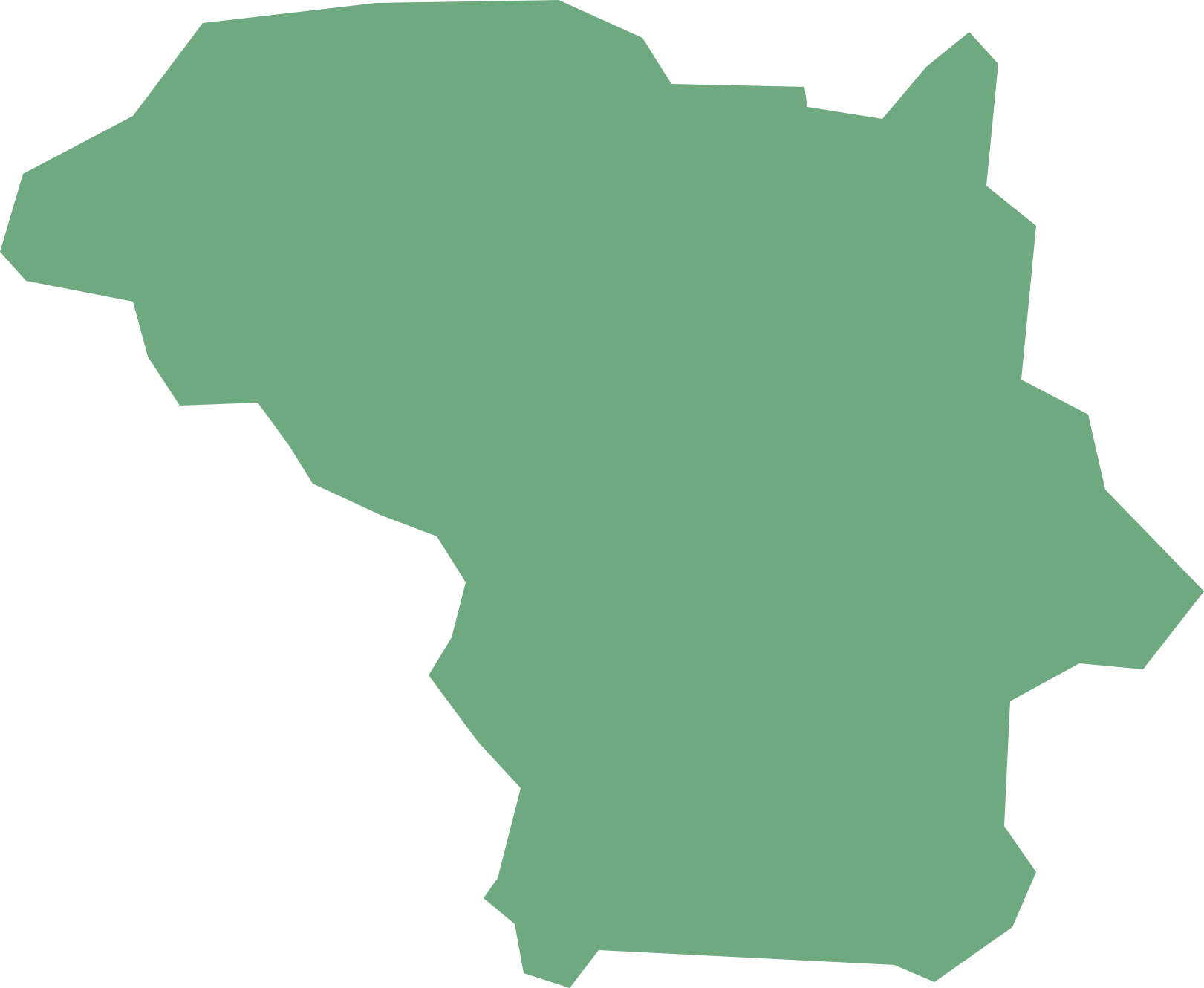
About Faridkot District (Punjab)
There is an interesting story associated with the name of the district. In 13th century the Faridkot town was founded by Raja Mokalsi and named the place Mokalhar after his name. During his kingdom one day a famous Sufi Saint Hazrat Baba Sheikh Farid happened to pass through this town. Baba Farid was captured by the soldiers of Raja Mokalsi and forced him to labour for the ongoing construction work of the fort at Mokalhar. When a basket full of earth was carried by Baba Farid was seen floating over his head then on seeing the miracle, Raja felt on feet of Baba Farid and begged pardon. Baba Farid pardoned the Raja and meditated at a place near the fort, where he penanced for forty days. From that day the name of Mokalhar was changed to Faridkot. Faridkot as a separate district came into existence on 7th August, 1972 since earlier it was a part of Bathinda District.
Harjeet Brar Bajakhana, a renowned kabaddi player was born on 5th September, 1971 at Bajakhana village of the district. In 1994 he made his International debut in Canada. During the final of 1996 Kabaddi World Cup, prize money of one lakhs rupees was awarded for his single winning raid.
Geographically, the district lies at 30°68' N latitude, 74°74' E longitude and 196 m altitude.In the year 2023, there was a total 1.12% forest area of total geographical area. The district occupies a geographical area of 1,458 sq. km. and it is bordered by Ferozepur District in the north west, Moga and Ludhiana Districts in the north east and Bathinda district and Sangrur district in the south. Mostly the climate of the district remains dry. The climate of the district is characterized by a very hot summer, a short rainy season and a refreshing winter. Most of its rainfall occurs in the monsoon season. The actual rainfall in the district was 358.4 mm in the year of 2024-2025.
Administrative wise, the district is divided into 8 sub divisions, 8 tehsils and 9 sub-tehsils. The administrative language in the district is Punjabi.
As per 2011 census the district has a population of 6,17,508 out of which 3,26,671 are males and 2,90,837 are females. The district has a sex ratio of 890 females for every 1000 males. Furthermore, the district has projected population of 7,53,045 comprising 3,98,891 males and 3,54,154 females for the year 2026. According to the National Family Health Survey (NFHS-5, 2019–21), the district has sex ratio of 924 females and a child sex ratio of 894 females per 1,000 males. During the year 2001-2011 the population growth rate of the district was 12.09% including 11.65% were males and 12.60% were females. The population density in the district is 424 persons per sq. km. In the year 2023 the number of live births in the district was 11,377 out of which 5,892 were males and 5,485 were females. In the same year the number of deaths in the district was 7,414 out of which 4,444 were males and 2,970 were females. According to 2011 census the major religions in the district are Sikh and Hindu with 76.08% and 22.89% of the total population. As per 2011 census the principal languages in the district is Punjabi with 91.79%.
The large size of the economy of the district is driven by agriculture. The chief agricultural items are wheat, rice, maize, sugarcane, potatoes, etc. Now- a- days the farmers of the district are applying some new agricultural technologies in order to fasten the pace of the productivity of crops. In the year 2022-2023 the Gross Domestic Product in the district was Rs. 13,29,016 lakh at current price and Rs. 9,10,523 lakh at constant 2011-2012 prices. The Net Domestic Product in the district during the period 2022-2023 was Rs. 11,62,054 lakh at current price and Rs. 7,86,768 lakh at constant 2011-2012 prices. The Per Capita Income or NDDP, At Factor Cost in the district during the period 2022-2023 was Rs. 1,65,042 at current price and Rs. 1,11,742 at constant 2011-2012 prices.
As per 2011 census the literacy rate of the district is 69.55% including 74.6% are males and 63.91% are females In addition, according to the Periodic Labour Force Survey (PLFS) for the period July 2023-June 2024 estimated literacy rate in the district is 83.71% including 93.22% are males and 75.54% are females (Age 7 Years and Above). Some of the important educational institutions of the district are Adesh Institute of Engineering & Technology, Baba Farid University of Health Sciences, Malwa College of Nursing, Baba Farid Law College, Govt Baljindra College, etc.
Gyani Zail Singh, the seventh President of India was born on 5th May, 1916 in Sandhwan, Faridkot district. He was a member of Indian National Congress party. Sukhbir Singh Badal, a well known politician and the Deputy Chief Minister of Punjab since 2009 was born on 9th July, 1962 in Faridkot. He is a member of Shiromani Akali Dal, a Sikh political party.
During the year 2018, there were 51,324 domestic tourists who visited the district. Every year the district attracts many travellers from different parts of the world. Natives believe that the foundation of the Qilla Mubarak (a fort) was laid by Raja mokalsi; Raka Hamir Singh. Later the rulers like Raja Bikram Singh, Raja Balbir singh got constructed many new buildings like Tosha Khana, Modi Khana & Treasury Buildings. Moreover, there is a garden within the four walls of the fort. During the kingdom of Maharaja Bikrama Singh (1885-1889), a royal palace named Raj Mahal was built in the French design and it spread over nearly 15 acres (61,000 m2). Its entrance is popularly known as “Raj Deori” it is a heritage building of a vintage. Darbar Ganj is a magnificent bungalow with a beautiful garden. Travellers from different places prefer Darbar Ganj for stay. Gurdwara Tilla (Chilla) Baba Farid is situated near the Qilla Mubarak. Everyday Shabad-Kirtan is recited and Langer (lunch) is also served to the people visiting this place. Some other centres of attraction of the district are Fairy Cottage, Check Tower, Shaheed Bhagat Singh Park and Victoria Clock Tower.