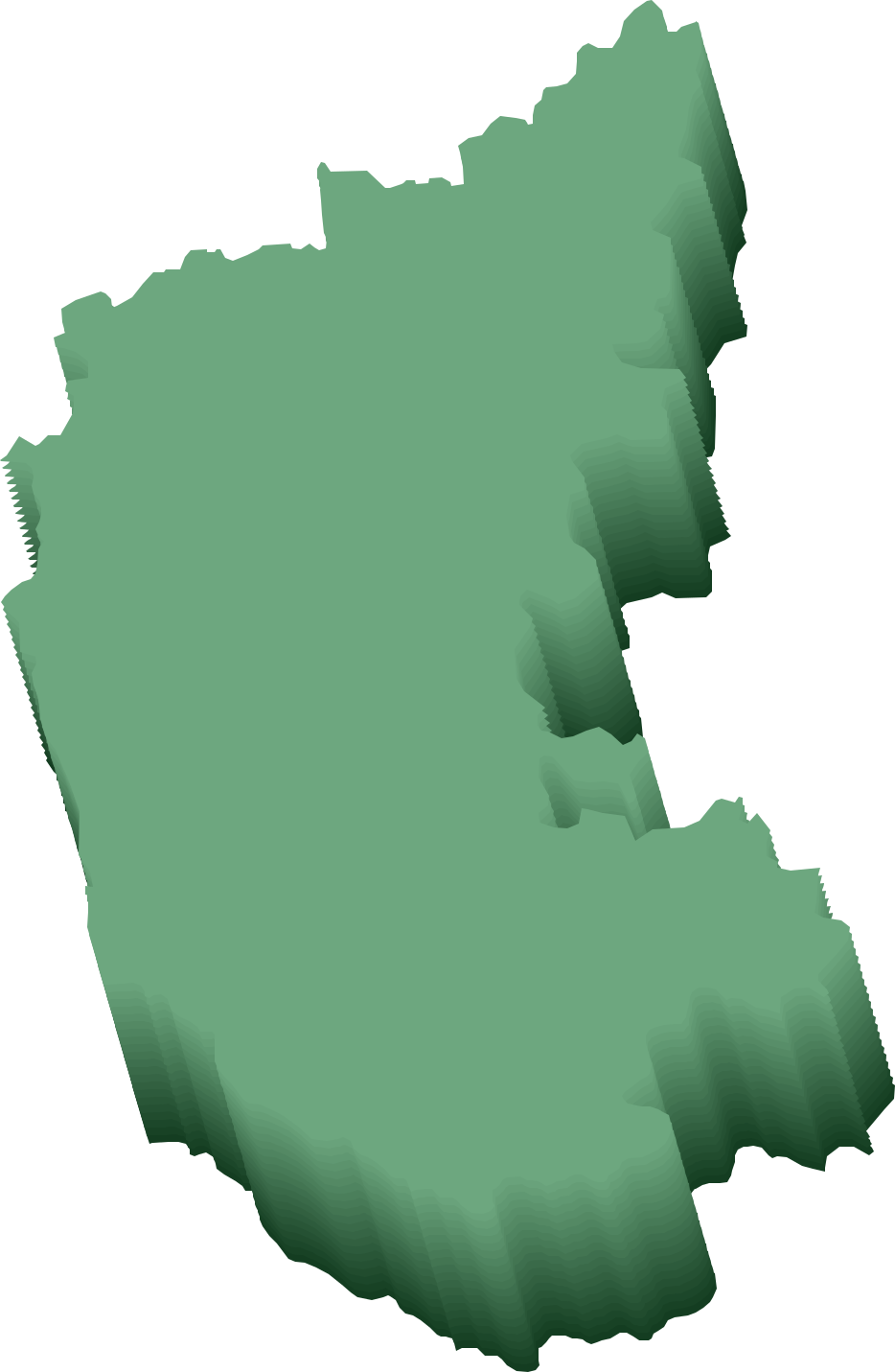
About Bengaluru Urban (Bangalore) District (Karnataka)
Bangalore, the capital of Karnataka is officially known as Bengaluru.The earliest reference to the name "Bengaluru" was found in a ninth-century Western Ganga Dynasty stone inscription on a "vira gallu" (literally, "hero stone", a rock edict extolling the virtues of a warrior). It states that it was a part of the Ganga Kingdom until 1004 and was known as "Bengaval-uru" means the "City of Guards". On 1st November, 1956 Bangalore was emerged as a separate district. On 11th December, 2005, the Government of Karnataka announced that they had received a proposal from the Jnanpith Award winner U. R. Ananthamurthy to rename Bangalore to Bengaluru. The government of Karnataka accepted the proposal, and in October 2014 the Union government has approved this proposal along with other 12 cities and Bangalore was renamed to "Bengaluru" on November 1st, 2014.
Chintamani Nagesa Ramachandra Rao also known as C.N.R. Rao, an eminent Indian chemist was born on 30th June, 1934 in Bangalore. He was honoured by many notable awards namely India Science Award (2004), Padma Shri (1974), Padma Vibhushan (1985) and Bharat Ratna (2013).
Geographically, the district lies at 12°97'N latitude, 77°59'E longitude and 900 m altitude. In the year 2023, there was a total 12.95% forest area of total geographical area. The district occupies a geographical area of 2,196 sq km. and it is bounded by Kolar district on the northeast, Tumkur district on the northwest, Mandya district on the southwest, Chamarajanagar district on the south and the neighbouring state of Tamil Nadu on the southeast. Bengaluru has a tropical savanna climate with distinct wet and dry seasons. The actual rainfall in the district was 775.4 mm in the year of 2024-2025.
Administrative wise, the district is divided into 3 Lok Sabha constituencies namely Rural Bengaluru, Central Bengaluru and Bengaluru South. Each of the 3 Lok Sabha constituencies has 8 different assembly constituencies. Moreover, the district comprises 4 sub-districts, 16 towns and 562 villages. The administrative language in the district is Kannada.
According to 2011 the district has a total population of 96,21,551 out of which 50,22,661 are males and 45,98,890 are females. The district has a sex ratio of 916 (females for every 1000 males). Furthermore, the district has projected population of 1,17,33,386 comprising 61,33,287 males and 56,00,099 females for the year 2026. According to the National Family Health Survey (NFHS-5, 2019–21), the district has an estimated sex ratio of 1,006 females and a child sex ratio of 1,156 females per 1,000 males. During the year 2001-2011 the population growth rate of the district was 47.18% including 46.58% were males and 47.85% were females. As per 2011 census the major religions of the district are Hindu and Muslim with 80.29% and 12.97% of the total population. The population density in the district is 4,381 persons per sq. km. According to 2011 census the principal languages in the district are Kannada and Tamil with 44.47% and 15.20%. In the year 2023 the number of live births in the district was 1,60,625 out of which 82,910 were males and 77,715 were females. In the same year the number of deaths in the district was 79,385 out of which 47,738 were males and 31,647 were females.
Bengaluru is popularly known as the Silicon Valley of India due to the large number of information technology (IT) companies located in it which contributes a large share of its economy. Infosys and Wipro, the third and fourth largest software companies of India are headquartered in Bengaluru. In the year 2005, around 47% of the 265 biotechnology companies in India were located in Bengaluru. Biocon, the largest biotechnology company of India is located in Bangalore. In the year 2023-2024 the Gross Domestic Product in the district was Rs. 10,10,09,638 lakh at current price and Rs. 5,74,01,345 lakh at constant 2011-2012 prices. The Net Domestic Product in the district during the period 2023-2024 was Rs. 9,52,58,781 lakh at current price and Rs. 5,36,66,061 lakh at constant 2011-2012 prices. The Per Capita Income or NDDP, At Factor Cost in the district during the period 2023-2024 was Rs. 7,47,797 at current price and Rs. 4,21,287 at constant 2011-2012 prices.
Schools in Bengaluru are run by either government or private organisations. The Bangalore University was established in the year 1886 which provides affiliation to over 500 colleges. Bengaluru has many private engineering colleges which are affiliated to the Visvesvaraya Technological University. St. John's Medical College (SJMC) and Bangalore Medical College and Research Institute are the renowned medical colleges of the district. As per 2011 census the literacy rate of the district is 87.67 % out of which 91.01% are males and 84.01% are females. The total number of literates in the district is 75,12,276 including 40,78,041 are males and 34,34,235 are females. In addition, according to the Periodic Labour Force Survey (PLFS) for the period July 2023-June 2024 estimated literacy rate in the district is 92.55% including 95.68% are males and 89.12% are females (Age 7 Years and Above).
Kengal Hanumanthaiya, a well-known Indian politician was born on 14th February, 1908 at Lakkappanahalli village near Ramanagara district in Bangalore. He was the second Chief Minister of Karnataka (then, Mysore State) from 30th March, 1952 to 19th August, 1956. He was a member of Indian National Congress. Ananth Kumar, a veteran politician was born on 22th July, 1959 in Bangalore. He is a member of Bharatya Janata Party. He represents the Bengaluru South Lok Sabha constituency in Karnataka where he has been elected consecutively for six times.
Bengaluru has the most amazing centres of attraction of the Karnataka. Lal Bagh is a botanical garden of Bangalore. In 1760 it was commissioned by the Hyder Ali. Cubbon Park is located in the heart of the Bengaluru city. Bangalore Fort was built by Kempegowda in 1537 A D. It is located next to the Victoria Hospital Gate in the K.R Market area. Tipu Sultan's Summer Palace was built in 179. It houses a museum that contains valuable things relating to the Hyder-Tipu regime. Bangalore Palace (1862) is situated near Mekhri Circle and Cantonment Railway station and is built to look like a smaller replica of the Windsor Castle in England. Mayo Hall was built in memory of the Lord Mayo and is regarded as one of the finest designs of British architecture. Some remarkable museums of the district are Government Museum, HAL Aerospace Museum, Madras Sappers Museum & Archives, Visvesvaraya Industrial and Technological Museum and Legends Motorcycle Museum. Bannerghatta National Park is located 22 km. south of Bengaluru. This hilly place is the home for one of the richest natural and zoological reserves. Butterfly Park of the district is comprises a butterfly conservatory, museum and an audio-visual room. It has been carefully designed to support over 20 species of butterflies. Bangalore Aquarium, established in 1983 is the second largest aquarium in India. It is located at the entrance of Cubbon Park in Bengaluru. During the year 2016, there were 84,061 foreign tourists and 1,04,91,350 domestic tourists who visited the district.