About Jhansi District (Uttar Pradesh)
Jhansi district is a district of Uttar Pradesh state with its administrative headquarters located at Jhansi city. The district is named after the headquarter city Jhansi. There is an interesting story associated with the name Jhansi. Once upon a time the king of Orchha was sitting with his friend, the king of Jaitpur on the roof of his palace and asked his friend that whether he could differentiate the new fort that was built by king of Orchha on Bangara hill. At that moment he replied that “he could see it” i.e. 'jhainsi' meaning rather in distinct. With the passage of time the name 'Jhainsi' transformed to 'Jhansi'. The Jhansi city along with a dependent territory was surrendered to Gwalior State in 1861. Moreover, the Jhansi Naoabad, a village without "cantonment" (military camp) was made the capital of the district. The old city Jhansi within the Gwalior state became the capital of a "subah" (province). But later in the year 1886 it came under the British rule as a district of the United Provinces of Agra and Oudh. Finally, in the year 1974 Jhansi was emerged as a separate district in the map of Uttar Pradesh.
Maithilisharan Gupt, an eminent modern Hindi poet was born on August 3rd, 1886 at Chirgaon in the Jhansi district. He is considered as one of the pioneers of Khari Boli poetry meaning plain dialect. He was also honoured by the prestigious Padma Bhushan Award in 1954.
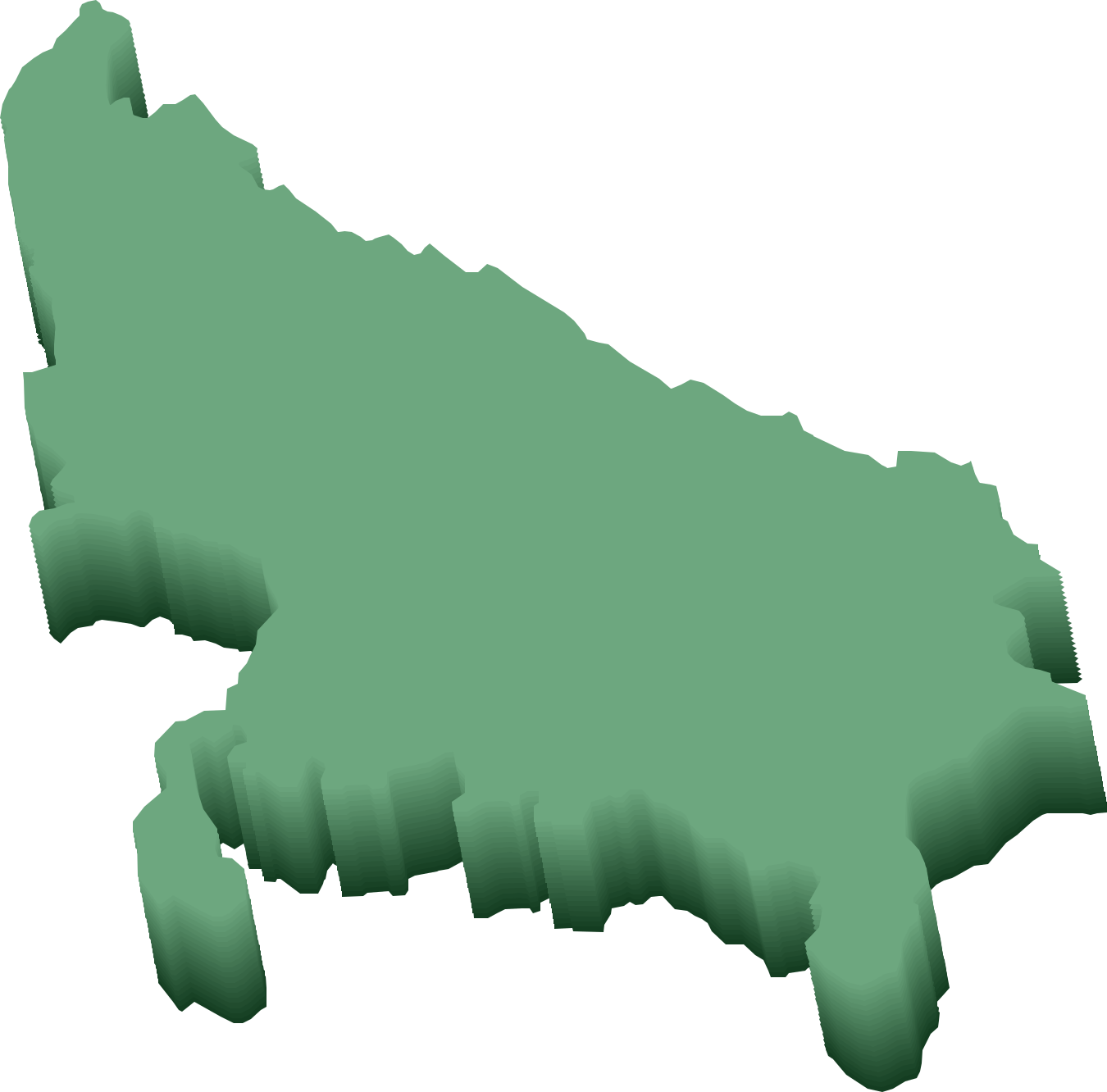
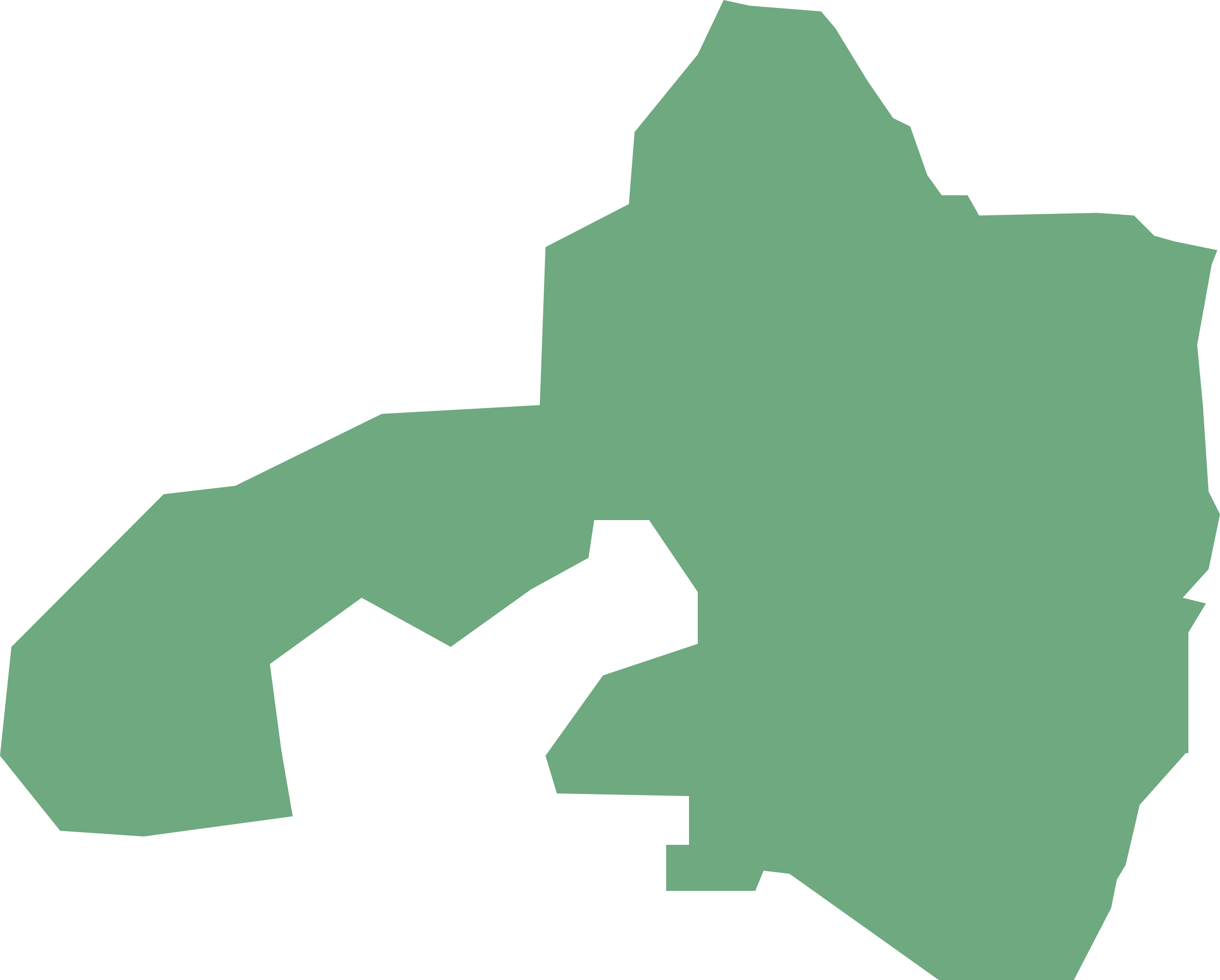
Geographically, the district lies at 25°44'N latitude, 78°57'E longitude and 284 m altitude. In the year 2023, there was a total 6.79% forest area of total geographical area. The district encompasses a geographical area of 5,024 sq. km. and in terms of geographical area it occupies the ranks of 9th in the state and 221st in India. It is bounded by Lalitpur district on the north and Madhya Pradesh on the south, east and west. The prominent river that flows through the district is Betwa. Most of its rainfall occurs during the monsoon season. The actual rainfall in the district was 726.6 mm in the year of 2024-25.
Administration wise, the district is divided into 5 tehsils namely Jhansi, Mauranipur, Moth, Tehroli and Garautha. There are 1 Lok Sabha seat and 5 Assembly constituencies in the district. Moreover, the district comprises 5 sub-districts, 19 towns and 816 villages. The administrative language in the district is Hindi.
According to 2011 census the district has a population of 19,98,603 out of which 10,57,436 are males and 9,41,167 are females. The district has a sex ratio of 890 females for every 1000 males. Furthermore, the district has projected population of 24,37,276 comprising 12,91,211 males and 11,46,065 females for the year 2026. According to the National Family Health Survey (NFHS-5, 2019–21), the district has an estimated sex ratio of 946 females and a child sex ratio of 876 females per 1,000 males. During the year 2001-2011 the population growth rate in the district was 14.54% including 13.36% were males and 15.89% were females. The population density in the district is 398 persons per sq. km. In the year 2023 the number of live births in the district was 60,858 out of which 33,142 were males and 27,716 were females. In the same year the number of deaths in the district was 12,891 out of which 8,553 were males and 4,338 were females. As per 2011 census the major religion in the district is Hindu with 91.26% of the total population. According to 2011 census the principal language in the district is Hindi with 98.76%.
To some extent the economy of the district is based on agriculture. Some of its chief agricultural products are wheat, barley, pea, gram, paddy, groundnut, different type of pulses, til, etc. The adoption of the new agricultural technologies amongst the farmers of the district helps to increase the production of various agricultural items. Every year a huge chunk of revenue also comes from the industries of the district. The foremost industries of the district are BHEL Jhansi, Heidelberg Cement Factory, Baidyanath Factory, Government Cotton Mill, Parichha Thermal Power Plant, Indian Hume Pipe Co. Ltd. Its silk materials and industries are not only famous in the country but also in the world. It exports its silk products to various parts of the world. In the year 2023-2024 the Gross Domestic Product in the district was Rs. 33,25,196 lakh at current price and Rs. 17,19,349 lakh at constant 2011-2012 prices. The Net Domestic Product in the district during the period 2023-2024 was Rs. 28,64,143 lakh at current price and Rs. 14,39,764 lakh at constant 2011-2012 prices. The Per Capita Income or NDDP, At Factor Cost in the district during the period 2023-2024 was Rs. 1,26,203 at current price and Rs. 63,440 at constant 2011-2012 prices.
The district is an abode of numerous reputed educational institutions. It provides platform for higher education. The district has two renowned universities namely Bundelkhand University and Rani Lakshmi Bai Central Agricultural University. Most of the colleges in the district are affiliated to Bundelkhand University which is a public university founded in 1975. Some of its recognised colleges are Arya Kanya College, Bipin Bihari College, Bundelkhand Degree College, Chandra Shekhar Azad Institute of Science & Technology, etc. As per 2011 census the literacy rate in the district is 75.05% including 85.38% are males and 63.49% are females. In addition, according to the Periodic Labour Force Survey (PLFS) for the period July 2023-June 2024 estimated literacy rate in the district is 82.62% including 91.14% are males and 74.40% are females (Age 7 Years and Above).
Pradeep Kumar Jain, an illustrious Indian politician and the former Minister of State in Ministry of Rural Development in 2009 was born on 8th September, 1962 at Jhansi city. He was also elected as a Member of Parliament in the 15th Lok Sabha from Jhansi constituency. He is a member of Indian National Congress party. Ram Prakash Gupta, a distinguished Indian politician and the 18th Chief Minister of Uttar Pradesh was born on 26th October, 1923 at the Jhansi city. He was also served as the governor of Madhya Pradesh. He was a leader of Bharatiya Janata Party.
During the year 2023, there were 1,10,20,736 domestic tourists and 1,544 foreign tourists who visited these places of the district. The district has numerous centres of attraction with historical and religious significance which allures many travellers from different parts of the country as well as world. Jhansi fort, situated on the top of a hill has thick granite walls and several bastions with mounted cannons. It includes the Rani Mahal which was the living quarters of Rani Lakshmi Bai but now it is an archaeological museum. Government Museum of Jhansi, established in 1878 is one of the well known places to find some rare archaeological gems of India. Chirgaon, a place located at a distance of 30 km. from Jhansi is renowned for its various ancient temples and scared ponds. Maharaja Gangadhar Rao Ki Chatri is dedicated and named after Maharaja Gangadhar Rao, the Maratha king that ruled Jhansi in the 19th century. This monument was built by Rani Lakshmi Bai for her husband in 1853 in a typical Maratha Hindu style. The district has also some other notable places of interest such as Barua Sagar, Parichha Dam, Maha Lakshmi temple, Ganesha mandir, St. Jude’s Shrine, etc.