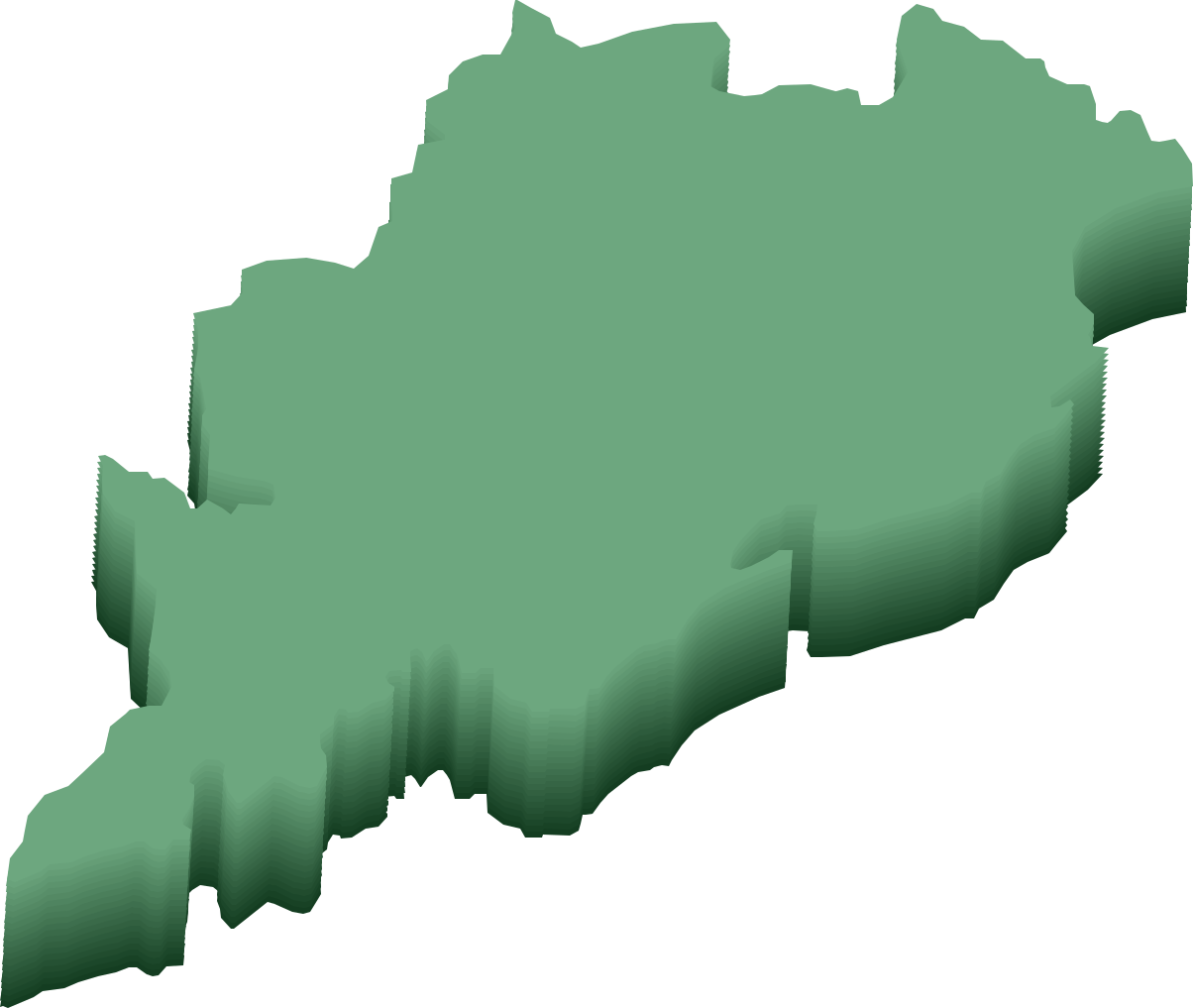
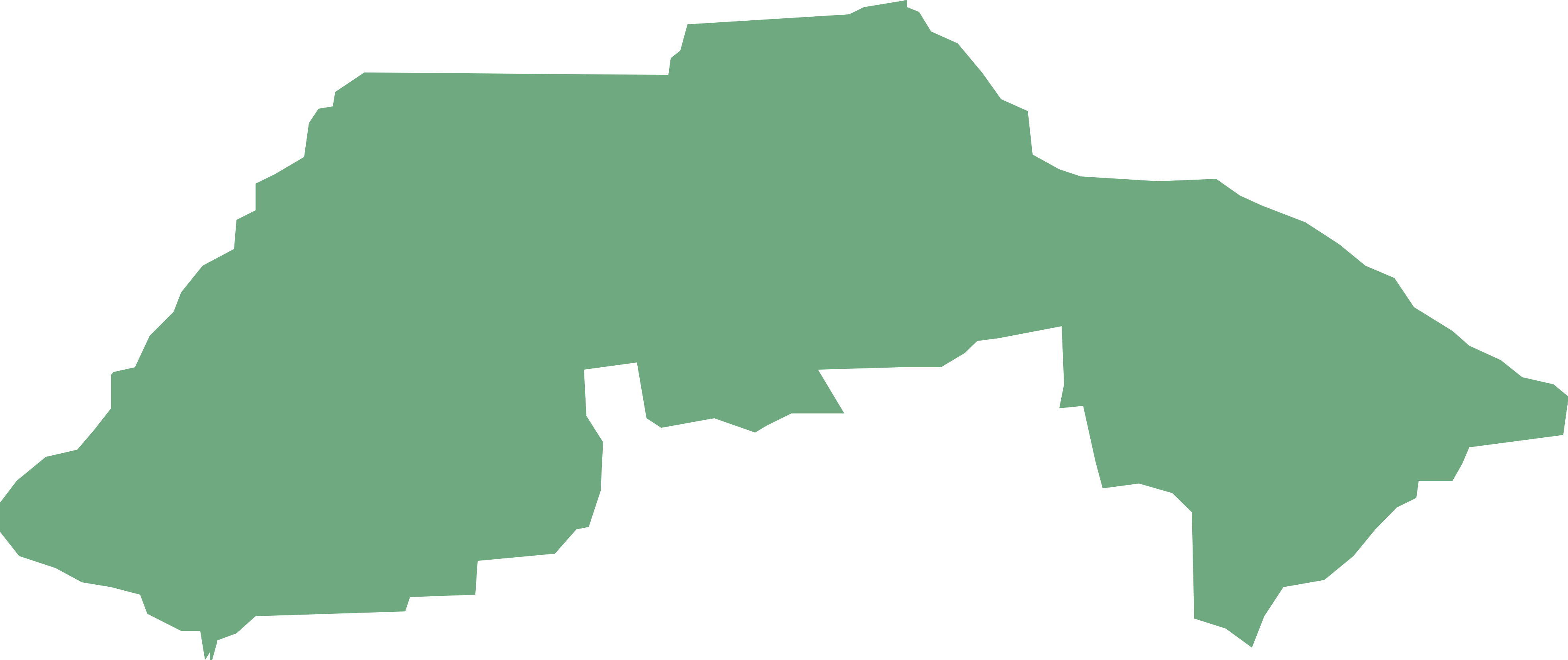
About Baudh District (Odisha)
Legends believe that the place of Boudh was a significant centre of Buddhist in Odisha since some beautiful Buddhist statues were found in it during an excavation. From the epigraphic records it has been cleared that Boudh region was under the occupation of the Bhanja rulers and was a part of Khinjali Mandala in the mid of the 8th century AD. Later, Boudh had Sonepur under its rule and emerged as a powerful emperor in the 1st half of the 17th century. It had a good relationship with Muslims during the period of Raja Pratap Dev. Boudh paid tribute to Marathas. In 1803 AD. Odisha was occupied by the British in AD. 1803, then Raja Biswambar Dev of Boudh surrendered to the British and entered into a treaty agreement with the British East India Company on 3rd March, 1804. After the Third Anglo Martha War, British Government permanently captured Boudh region from the Marathas and included this state in the South West Frontier Agency till the year 1837, when it was brought under the superintendent of Tributary Mahals, Cuttack. In this way, the place of Boudh was ruled by different rulers during different periods of time.
Geographically, the district has a total 3,098 sq. kms. area and occupies the rank 22nd in State and 391st in India on the bases of this size. It lies at 20°83'N latitude, 84°32'E longitude and 518 m altitude. In the year 2023, there was a total 42.21% forest area of total geographical area. The district is surrounded by River Mahanadi and Anugul district to the North, Kandhamal district to the South, Nayagarh district to the East and River Tel and Subarnapur district to the West. Black alluvial soil is available in most of the parts of the district. Mahanadi and the Tel are the major rivers here. The climate of the district is extremely hot in the summers and fairly cold in the winters. Most of its rainfall occurs in the monsoon season. The actual rainfall in the district was 1347.5 mm in the year of 2024-2025.
Administration wise, the district is divided into 6 sub-districts, 1 town and 1,187 villages. Oriya is its official language. It came into existence on 1st April, 1993 with its administrative headquarters located at Baudh which is situated at a distance of 213 kms. from the state capital.
Demographically, according to the 2011 census, the district has a total number of 1,07,727 households with a total population of 4,41,162 comprising 2,21,625 are males and 2,19,537 are females which leads it to rank 29th in the state and 552nd in India. The density of population of the district is 142 (persons per sq kms). The sex ratio is pegged at 991 (females per 1000 males) while the child ratio stands at 978 (females per 1000 males). Furthermore, the district has projected population of 5,37,993 comprising 2,70,661 males and 2,67,332 females for the year 2026. According to the National Family Health Survey (NFHS-5, 2019–21), the district has sex ratio of 1,009 females and a child sex ratio of 821 females per 1,000 males. As per 2011 census the percentage of major religion practiced by the people of this region is Hindu with 99.32%. The population growth rate during the period of 2001-2011 was 18.16% including 17.79% were males and 18.53% were females. According to 2011 census the principal language in the district is Oriya with 99.31%. In the year 2023 the number of live births in the district was 5,504 out of which 2,829 were males and 2,675 were females. In the same year the number of deaths in the district was 3,744 out of which 2,021 were males and 1,723 were females.
Economically, the district is dependent on agriculture primarily. In the year 2011-2012 the Gross Domestic Product in the district was Rs. 1,43,797 lakh at current price and Rs. 87,665 lakh at constant 2004-2005 prices. The Net Domestic Product in the district during the period 2011-2012 was Rs. 1,32,071 lakh at current price and Rs. 79,633 lakh at constant 2004-2005 prices. The Per Capita Income or NDDP, At Factor Cost in the district during the period 2011-2012 was Rs. 29,776 at current price and Rs. 17,953 at constant 2004-2005 prices. At present Baudh district is one of the backward districts in Odisha which is receiving funds from the Backward Region Grant Fund (BRGF). The Government launched its Swaranjayanti Gram Swarozgar Yojana (SGSY) in the district in year 1999. Rice, wheat, maize, pulses, millets are main crops, grown here.
Education wise, according to the 2011 census, the literacy rate in the district is 71.61% including 83.34% are males and 59.79% are females. The literate population of the district is 2,71,612 out of which 1,58,648 are males and 1,12,964 are females. In addition, according to the Periodic Labour Force Survey (PLFS) for the period July 2023-June 2024 estimated literacy rate in the district is 78.95% including 77.01% are males and 80.59% are females (Age 7 Years and Above). Panchayat High School, Badhigaon High School, Aryan Academy, Bahira Toup School, Bausuni High School, Kandikanapa Ugme School, Shree Jagannath High School, Maa Maheswari Degree College, Bhairabi Degree College Boudh Panchayat Degree College are some of the most reputed educational institutions in the district.
The district has several famous historical and religious places to visit. These places are Buddha Statue, Ramanath Temple, Jogindra Villa Palace, Hanuman Temple, Chandra Chuda & Matengeswar Temple, Bhiarabi and Madan Mohan Temple, Jagannath Temple, Raghunath Temple at Debagarh, Jagati, Purunakatak, Padmatola Sanctuary and Satakosia Gorge, Dambarugada Mountain, Nayakpada Cave, Marjakud is a wonderful island of Baudh. In the year 2019, there were total 2,88,081 domestic tourists who visited the above places.