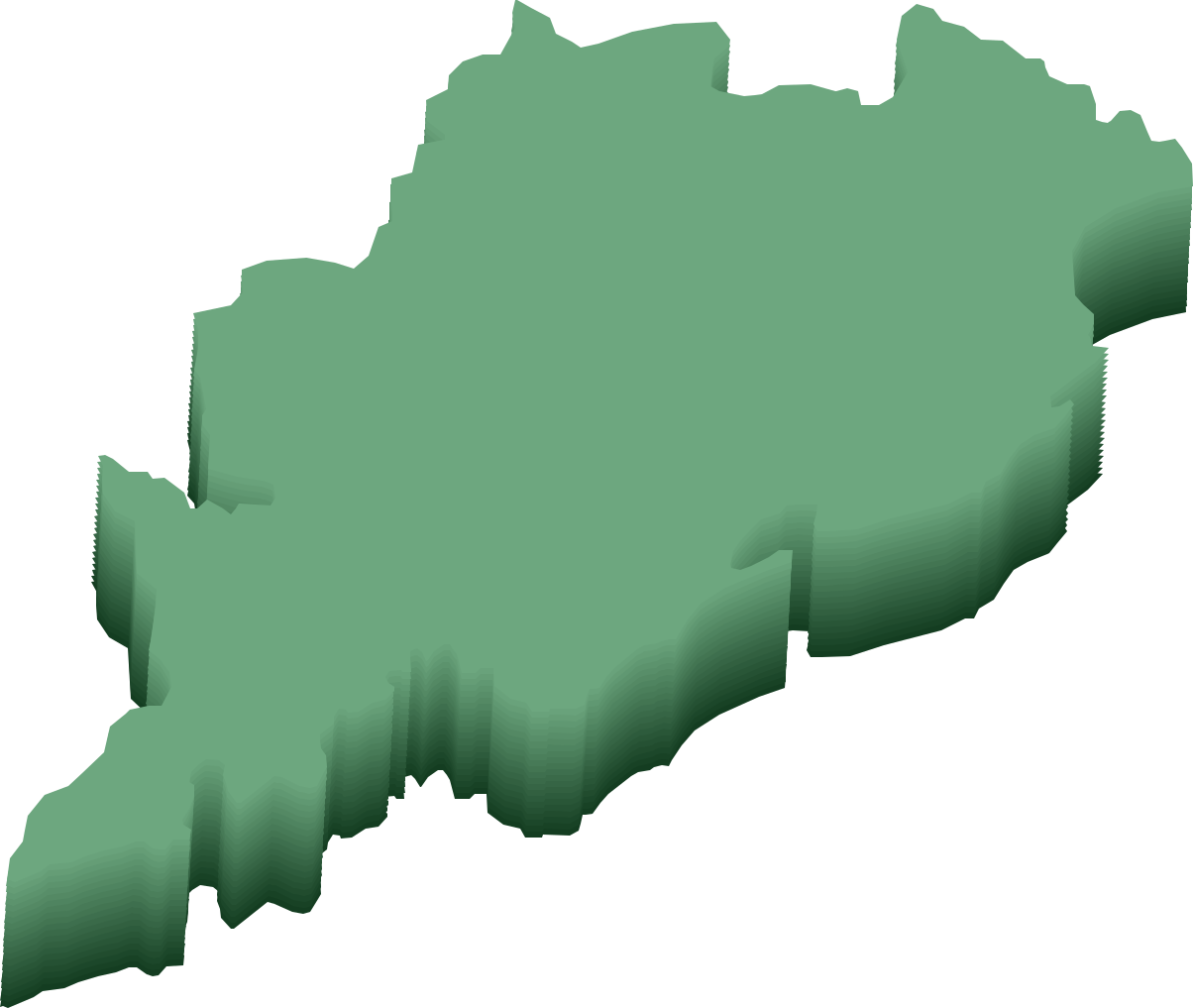
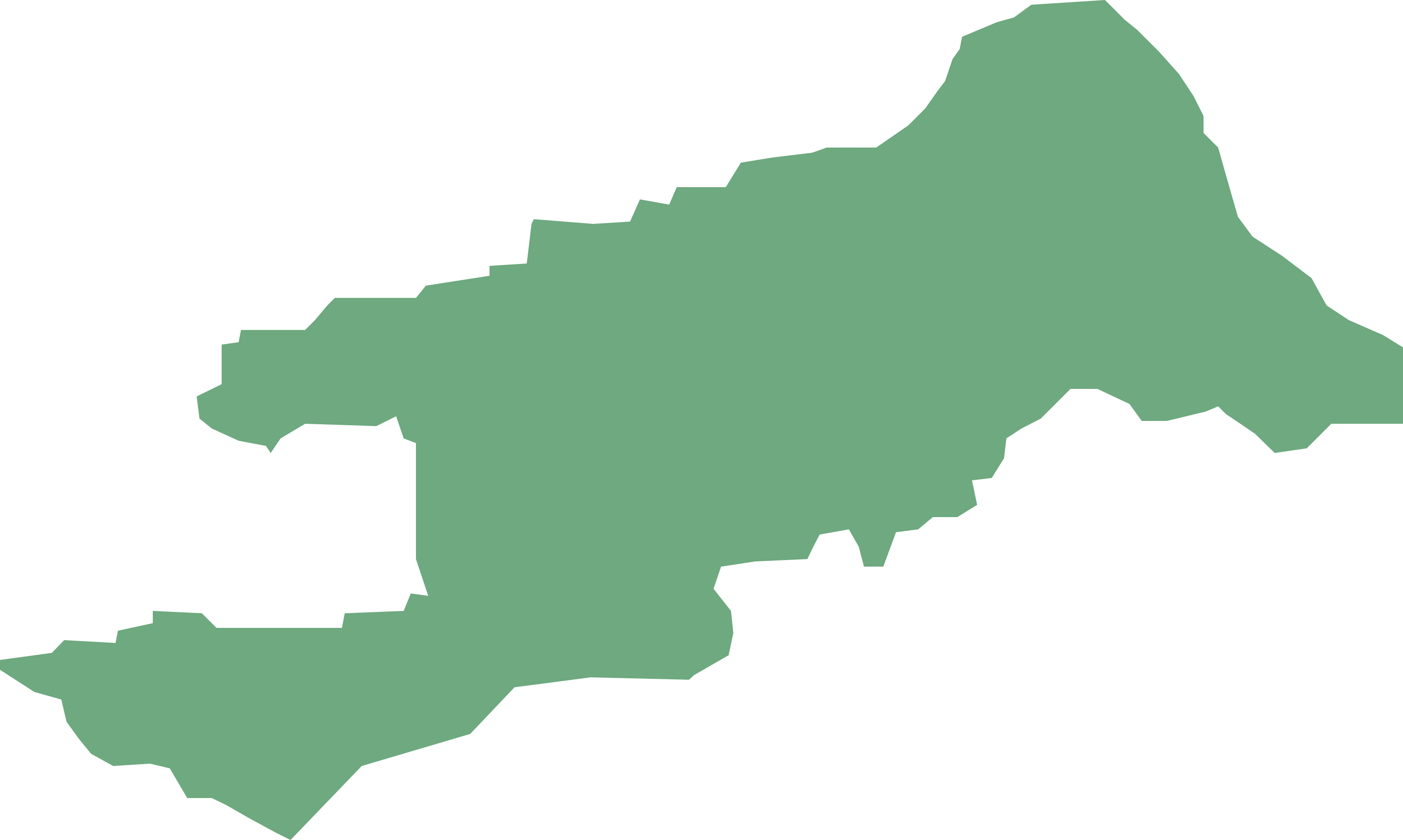
About Khordha District (Odisha)
For the first time on 1st April, 1993 the place of Khurda was emerged as a separate district after carved out from its erstwhile Puri district which later divided into Puri, Khurda and Nayagarh. Then the name of the district was changed as Khordha in the year 2000. According to the historical documents, the British captured the Khurda district in 1803. The region is well-known for Barunei temple, situated at the top of the Barunei Hill. The area of Khurda came into lime light when the first king of the Khordha dynasty named Ramachandra Deva declared it as the capital of his empire during the later part of the 16th century AD. At that time the Bhoi kings resided in a part of the foot of the Barunei Hill, located at a distance of 1.6 kms. to the south of the town. They selected this site because it was protected on one side by the Barunai Hill and on the other by dense forest. From the very beginning, Khurda suffered a lot because of the repeated attacks from Muslim and Maratha cavalry but inspite of all these attacks its royal house gained much of its independence till the year 1804. During this period the then king Mukunda Devaunder under the guidance of Jaya krushna Rajguru, rebelled against the British dominion and was then dispossessed of his territory. The present day’s Khurda is an important centre of handloom industry.
Arabinda Muduli is a musician, singer and lyricist. He is a very famous Bhajan singer. He was honored with Swar Srikshetra by the Governor of Odisha. Manasi Pradhan is an author and Indian women activist. She also founded Nirbhaya Vahini and OYSS Women. She was honored with the Rani Lakshmibai Stree Shakti Puraskar in 2013 and the 'Outstanding Women Award' in 2011 from the United Nation.
Geographically, the district has a total 2,813 sq. kms. area and occupies the rank 25th in State and 417th in India on the bases of this size. It lies at 20°19'N latitude, 85°63'E longitude and 75 m altitude. In the year 2023, there was a total 18.86% forest area of total geographical area. It is bounded by Nayagarh district, Ganjam district, Cuttack district and Puri district. The climate of the district is a extremely hot in the summers and fairly cold in the winters. Most of its rainfall occurs in the monsoon season. The actual rainfall in the district was 1364.5 mm in the year of 2024-2025.
Administration wise, the district is divided into 22 sub-districts, 13 towns and 1,534 villages. Oriya is its official language. It came into existence on the 1st April, 1993 with its administrative headquarters located at Khordha town which is situated at a distance of 27 kms. from the State Capital.
Demographically, according to the 2011 census, the district has a total number of 4,89,636 households with a total of 22,51,673 comprising 11,67,137 are males and 10,84,536 are females which leads it to rank 5th in the state and 201st in India. The density of population of the district is 800 (persons per sq. kms.). The sex ratio is pegged at 929 (females per 1000 males) while the child ratio stands at 916 (females per 1000 males). Furthermore, the district has projected population of 27,45,893 comprising 14,25,246 males and 13,20,647 females for the year 2026. According to the National Family Health Survey (NFHS-5, 2019–21), the district has sex ratio of 1,024 females and a child sex ratio of 787 females per 1,000 males. As per 2011 census the percentage of major religions practiced by the people of this region is Hindu with 95.38% of the total population. The population growth rate during the period of 2001-2011 was 19.94% including 18.26% were males and 21.79% were females. According to 2011 census the principal language in the district is Oriya with 92.13%. In the year 2023 the number of live births in the district was 44,300 out of which 23,484 were males and 20,816 were females. In the same year the number of deaths in the district was 29,162 out of which 17,763 were males and 11,399 were females.
Economically, the district is dependent on agriculture primarily. In the year 2011-2012 the Gross Domestic Product in the district was Rs. 15,24,205 lakh at current price and Rs. 9,88,828 lakh at constant 2004-2005 prices. The Net Domestic Product in the district during the period 2011-2012 was Rs. 12,83,328 lakh at current price and Rs. 8,17,893 lakh at constant 2004-2005 prices. The Per Capita Income or NDDP, At Factor Cost in the district during the period 2011-2012 was Rs. 56,618 at current price and Rs. 36,084 at constant 2004-2005 prices. The district is famous for its brass utensils cottage industries, cable factory, spinning mills, watch repairing factory, railway coach repairing factory, oil industries, Coca-Cola bottling plant and small metal industries.
Education wise, according to the 2011 census, the literacy rate in the district is 86.88% out of which 91.78% are males and 81.61% are females. The total literate population of the district is 17,49,936 including 9,57,515 are males and 7,92,421 are females. In addition, according to the Periodic Labour Force Survey (PLFS) for the period July 2023-June 2024 estimated literacy rate in the district is 89.78% including 93.06% are males and 86.04% are females (Age 7 Years and Above). International Institute of Information Technology, Bhubaneswar, International Management Institute (IMI), KIIT University, National Institute of Science Education and Research, Orissa University of Agriculture and Technology, Siksha 'O' Anusandhan University, Dr. Abhina Chandra Homoeopathic Medical College, All India Institute of Medical Sciences, Capital Law College, All India Institute of Industrial Technology, Deba Ray College, Asian School of Business Management, Bhubaneswar Model Public School, Carmel English School, Doon International School, Kendriya Vidhalya, etc. are some of the main educational institutes in the district.
Shashi Bhusan Behera, a veteran member of the Biju Janata Dal party is a Member of the Legislative Assembly of Odisha and a former member of the Rajya Sabha. Ranganath Misra MA, LLM served as the 21st Chief Justice of India and as the first chairman of the National Human Rights Commission of India.
The district has many famous historical and religious places to visit. These places are Chilika (Barkul), Dhauli, Khandagir & Udayagiri, Khandagir & Udayagiri, Atri, Nandan Kanan, Rameswar, Hirapur. 7000 Temples in Ekamra Vana of Bhubaneswar. In the year of 2019, there were total 93,69,440 domestic tourists and 60,463 foreign tourists who visited here.