About Pali District (Rajasthan)
Historically, the word Pali is used as a name for the language of the Theravada canon. In the 19th century Robert Caesar Childers argued that the true or geographical name of the Pali language was Magadhi Prakrit. Pali means line, row or series, so the early Buddhists extended the meaning of the term to mean a series of books, so Palibhasa means language of the texts. However, modern scholarship has regarded Pali as a mix of several prakrit languages from around the 3rd century BCE, combined together and partially Sanskritaised. Many Theravada sources refer to the Pali language as "Magadhan" or the "language of Magadha" and may have been an attempt by Buddhists to associate them more closely with the Maurya Empire. Till the end of the 7th century Pali was dominated by Rajputs. The Chalukya King Harshavardhana rules Pali along with other parts of Rajasthan till the end of 7th century. Mewar, Godwad and Marwar were including in Pali from 10th to 15th century. The surrounding areas of Pali witnessed a number of battles. Maharaja Vijay Singh rehabilitated Pali and made it an important commercial center. According to Geologists, Pali had existence in pre historic age also. Meera Bai was a Hindu mystic poet and devotee of Krishna of the 16th century.
Adho Duraso also known as Arha Dursa was born in the year 1538, to Mahoji at Jaitaran in the Pali district. He died in 1651. He was a Rajasthani-language poet of medieval peroid and was the ruler of 5 villages. He was known for his bravery and great work in poetry.
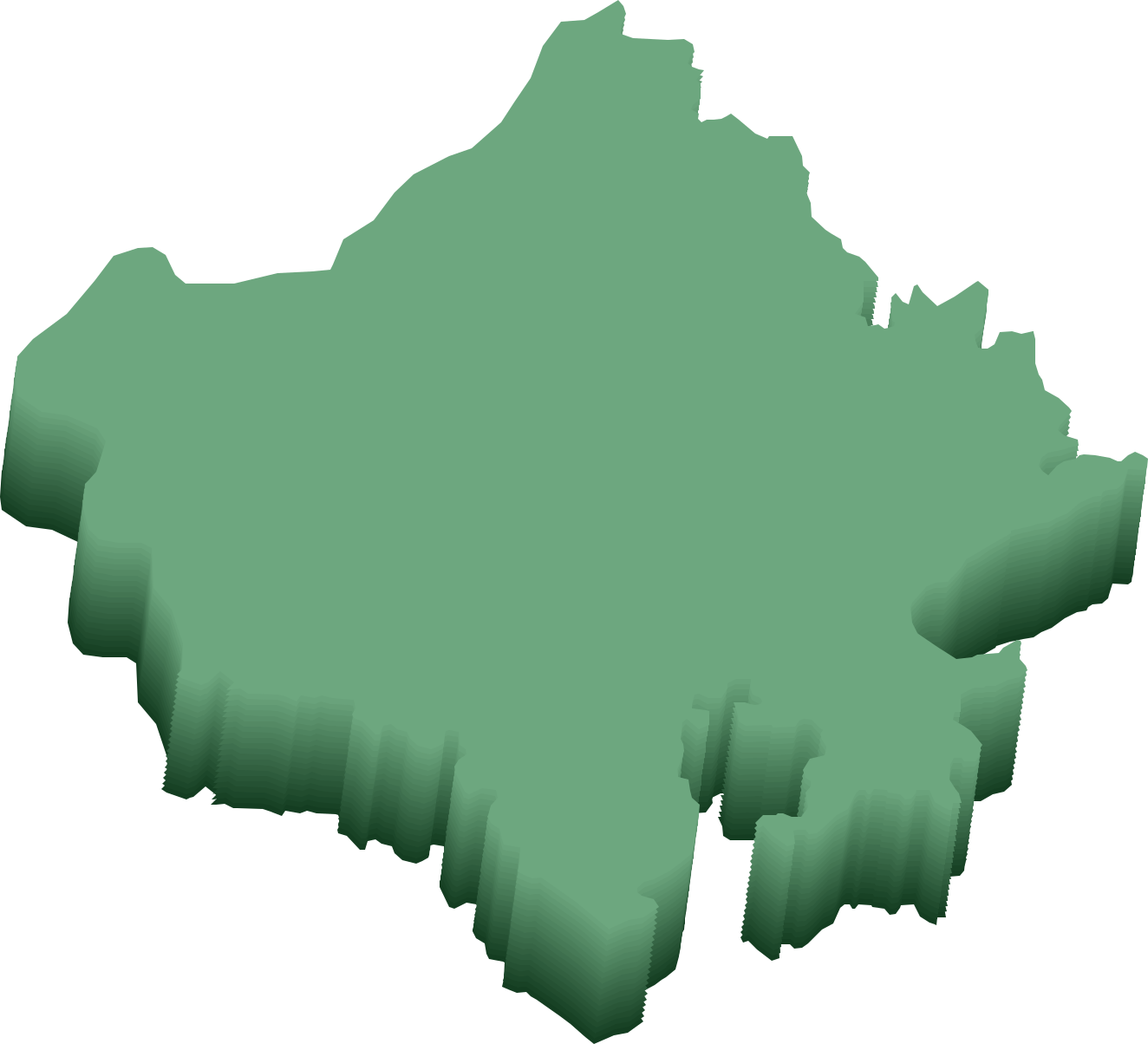
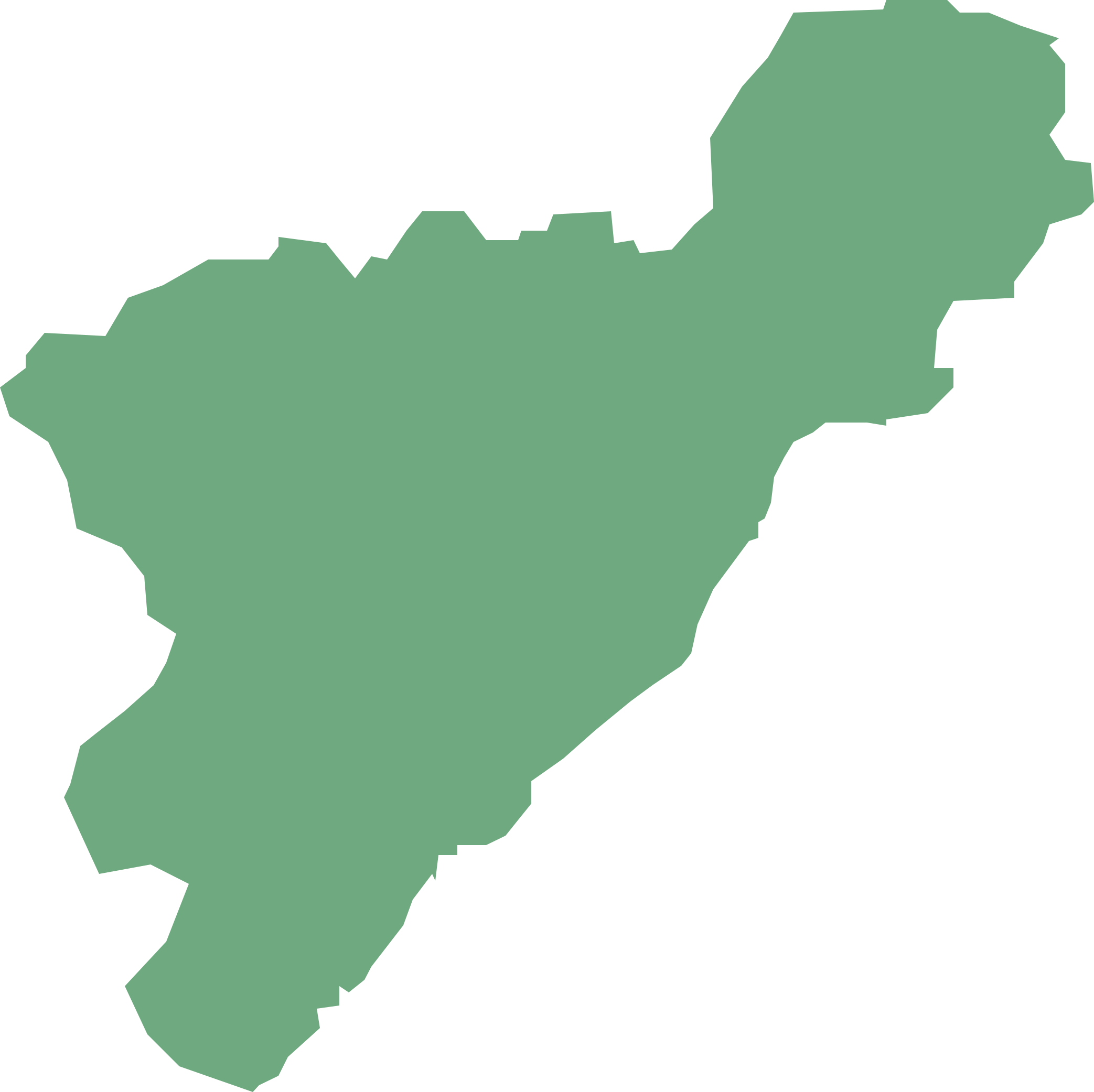
Geographically, it lies at 25°77'N latitude, 73°32'E longitude and 214 m altitude. Pali district is situated in the state of Rajasthan in western India. The district covers to a geographical area of 12,387 sq km. and ranks 7th in the State and 34th in India on basis of this size. As per data recorded in the year 2023, there was a total 5.59% of the total geographical area of the district. Pali is bounded by Nagaur District in the north, Ajmer District in the northeast, Rajsamand District in the east, Udaipur District in the southeast, Sirohi District in the southwest, Jalore District and Barmer District in the west, and Jodhpur District in the northwest. The eastern boundary of the district is formed by Aravalli Range in the East and Bamnera village in (Sumerpur Tehsil) the south. Many tributaries of the Luni River originate through a zone of foothills in the West of the district and comprise the alluvial plain of the Luni. Roadways and railways are the only two modes of travel, available in the district. Guhiya, Khari, Bandi, Mithari Sukri, Luni and Jawai Rivers passes through the district. The climate of the district is extremely hot in the summers and fairly cold in the winters. Most of its rainfall occurs in the monsoon season. The actual rainfall in the district was 788.8 mm in the year of 2024-2025.
Administratively, district of Pali came into existence in the state of Rajasthan with an allotted district code of 118. Its district Headquarters is at Pali which is located at a distance of 300 kilometers from the State Capital. It is divided into 9-sub-districts namely Sojat, Marwar Junction, Jaitaran, Raipur, Sumerpur, Bali, Pali, Rohat and Desuri. Moreover, it has 11 towns and 1,030 villages. The administrative language in the district is Hindi.
Demographically, according to 2011 census, the district has a total number of 4,28,992 households with a total population of 20,37,573 including 10,25,422 are males and 10,12,151 are females and having rank 14th in the state and 225 in India. The population growth rate during 2001-2011 was 11.94% including 11.60% were males and 12.29% were females. The density of population of the district is 164 persons per sq km. The sex ratio is pegged at 987 (females per 1000 males) while the child ratio stands at 899 (females per 1000 males). the population density in the district is 164 (persons per sq. km.). Furthermore, the district has projected population of 24,84,800 comprising 12,52,297 males and 12,32,503 females for the year 2026. According to the National Family Health Survey (NFHS-5, 2019–21), the district has an estimated sex ratio of 1,085 females and a child sex ratio of 986 females per 1,000 males. As per 2011 census the major religion in the district is Hindu with 91.80% of the total population. According to 2011 census the principal language in the district is Hindi with 99.55%. In the year 2023 the number of live births in the district was 60,438 out of which 31,789 were males and 28,647 were females. In the same year the number of deaths in the district was 15,376 out of which 9,146 were males and 6,229 were females.
Economically, agriculture is the backbone of the district. In the year 2023-2024 the Gross Domestic Product in the district was Rs. 43,73,203 lakh at current price and Rs. 23,02,274 lakh at constant 2011-2012 prices. The Net Domestic Product in the district during the period 2023-2024 was Rs. 39,21,994 lakh at current price and Rs. 20,13,592 lakh at constant 2011-2012 prices. The Per Capita Income or NDDP, At Factor Cost in the district during the period 2023-2024 was Rs. 1,61,828 at current price and Rs. 83,084 at constant 2011-2012 prices. Mehandi manufacturing units, textile dyeing and printing, umbrellas and wire netting, cotton ginning, ACSR conductors, agricultural equipment, conduct pipes, cement (Portland), Guar gum, handle manufacturing units, medicines, pesticides, steel furniture industries are found there. Mandia road (Pali), Old Industrial Area (Pali), Pali I Phase, Pali II Phase, Pali IV Phase, Marwar Junction, Punayata Road (Pali), Piplia Kalan, Sojat City I & II Phase, Sojat City III Phase, Sumerpur Industrial Area, Sumerpur Industrial Estate, M/s DLF Cement Ltd. Rabariyawas, Industrial Area Bar, Industrial Area Saradhana, Rani Industrial Area and Falna-Zadri are 15 industrial areas which are established and developed by the state government to promote industries in the region.
Educationally, according to 2011 census, the percentage of literate persons is 62.39% out of which 76.81% are males and 48.01% are females. The total literate population of the district is 10,85,693 including 6,67,381 males and 4,18,312 females. In addition, according to the Periodic Labour Force Survey (PLFS) for the period July 2023-June 2024 estimated literacy rate in the district is 70.33% including 88.30% are males and 54.51% are females (Age 7 Years and Above).
There are various primary, Upper Primary, secondary and higher secondary level school and colleges which are established under ‘education policy of 1986’. Some important colleges are Mahaveer Bal Mandir Senior Secondary School (MBM), Bangur Government College, Government Girls College, Shree Paramhans Swami Madhavanand College, Shree Paramhans Swami Madhavanand College, Marwar College, Sajjan International College, Shree Vinayak Vidyapeeth, Saraswati Teachers Training College, R.C. Memorial Shikshak Prakshishan Mahavidhyalay, etc.
During 2024, there were 67,329 foreign tourists and 16,75,789 domestic tourists who visited various historical and religious places of the district like Jawai Dam, Om Banna, Dargah of Pir Mastan Mosque, Adinath Temple, Nimboka Nath Temple, Parsvanath Temple, Bangur Museum, Tapeshwar Mahadev Temple, Gajanand Temple, Surya Narayana Temple and Lakhotia Garden.